
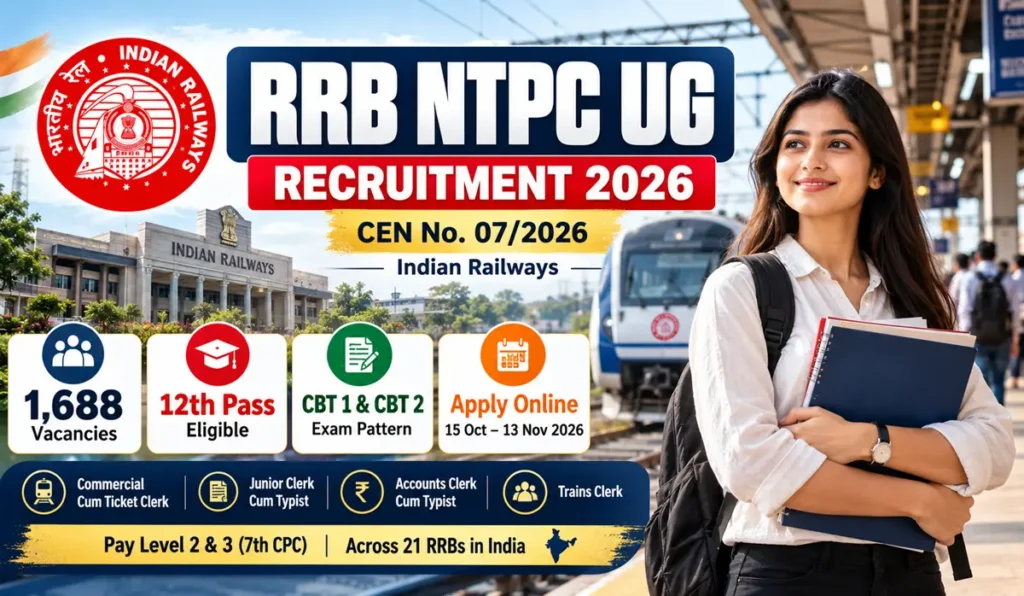
The Railway Recruitment Board (RRB) has officially released the detailed Centralised Employment Notification (CEN No. 07/2026) for RRB NTPC UG Recruitment 2026 to fill 1,688 undergraduate-level vacancies across 21 Railway Recruitment Boards in Indian Railways. If you have completed your 12th standard (+2 stage) and dream of securing a stable, respectable, and rewarding career in Indian Railways, this article provides the complete, authentic, and step-by-step guide to the RRB NTPC UG Recruitment 2026 with a central focus on the official syllabus, exam pattern, subject-wise topic breakdown, selection stages, post details, eligibility rules, and preparation strategy.
Understanding the official RRB NTPC UG Recruitment 2026 syllabus and examination pattern is the first and most critical step for every railway job aspirant. Candidates who align their daily study routine with the exact subject-wise topics mentioned in CEN 07/2026 stand a significantly higher chance of scoring top marks in Computer Based Test 1 (CBT 1) and Computer Based Test 2 (CBT 2).
RRB NTPC UG Recruitment 2026: Official Overview
The RRB NTPC UG Recruitment 2026 brings excellent opportunities for 12th-pass candidates to join non-technical cadre positions under Level 2 and Level 3 of the 7th Central Pay Commission (CPC). Below is a comprehensive overview table outlining the key highlights of the official notification (CEN No. 07/2026).
| Parameter | Details & Official Specifications |
|---|---|
| Exam Name | RRB Non-Technical Popular Categories (Undergraduate) Recruitment 2026 |
| Notification Number | CEN No. 07/2026 |
| Conducting Authority | Railway Recruitment Boards (RRBs), Ministry of Railways |
| Total Vacancies | 1,688 Provisional Undergraduate Posts |
| Target Posts | Commercial Cum Ticket Clerk, Junior Clerk Cum Typist, Accounts Clerk Cum Typist, Trains Clerk |
| Pay Level | Pay Level 2 and Level 3 (7th CPC) |
| Minimum Educational Qualification | Class 12 (+2 Stage) or equivalent with minimum 50% aggregate marks (Exemptions apply) |
| Age Limit (as on 01.01.2027) | 18 to 30 Years for Unreserved / EWS candidates (Category relaxations applicable) |
| Selection Process | 1st Stage CBT \(\rightarrow\) 2nd Stage CBT \(\rightarrow\) Document Verification \(\rightarrow\) Medical Examination |
| Computer Based Typing Skill Test | Dispensed with / Cancelled for CEN 07/2026 (Assessed after joining) |
| Mode of Application | Online Only via unified portal (rrbapply.gov.in) |
| Application Window | 15th October 2026 to 13th November 2026 (23:59 Hours) |
| Fee Payment Deadline | 15th November 2026 |
| Application Modification Window | 16th November 2026 to 25th November 2026 (₹250 per modification) |
| Official Website | Visit Official Website |
Table of Contents
Table of Contents
RRB NTPC UG Recruitment 2026 (CEN 07/2026)
The Ministry of Railways has implemented crucial administrative and examination policy modifications in the RRB NTPC UG Recruitment 2026 notification compared to earlier recruitment cycles:
- Dispensation of Computer Based Typing Skill Test (CBTST): In a major candidate-friendly reform, RRB has completely done away with the separate typing skill test for Junior Clerk Cum Typist and Accounts Clerk Cum Typist posts. Typing proficiency will now be evaluated after joining service during the training or probation period.
- No Aptitude Test (CBAT): None of the four undergraduate posts notified under CEN 07/2026 requires the Computer Based Aptitude Test (CBAT / Psycho Test).
- Unified Online Application Portal: All applications must be filled strictly through the unified web portal
rrbapply.gov.inusing One-Time Registration (OTR) / Create an Account credentials. - Live Photograph Capture: Pre-printed photo uploads are disallowed; candidates must capture a live photograph using a camera/webcam during the online application process.
- Aadhaar-Seeded Identity & Fee Refund: Fee refunds for candidates who appear in CBT 1 will be credited directly to Aadhaar-seeded bank accounts.
RRB NTPC UG Vacancy 2026: Post-Wise Vacancy & Salary Structure
The 1,688 undergraduate vacancies under RRB NTPC UG Recruitment 2026 are distributed across four distinct job profiles in Pay Level 2 and Level 3. Understanding the post hierarchy, initial basic pay, medical standards, and category-wise distribution helps candidates make informed choices while selecting post preferences during application submission.
Post-Wise Vacancy & Pay Level Table
| Post Code / Category Name | Pay Level (7th CPC) | Initial Basic Pay | Medical Standard | UR | SC | ST | OBC (NCL) | EWS | Total Vacancies |
|---|---|---|---|---|---|---|---|---|---|
| Commercial Cum Ticket Clerk | Level 3 | ₹21,700 | B-2 | 276 | 106 | 64 | 178 | 76 | 700 |
| Junior Clerk Cum Typist | Level 2 | ₹19,900 | C-2 | 259 | 95 | 59 | 137 | 50 | 600 |
| Accounts Clerk Cum Typist | Level 2 | ₹19,900 | C-2 | 79 | 29 | 17 | 53 | 22 | 200 |
| Trains Clerk | Level 2 | ₹19,900 | A-3 | 72 | 28 | 27 | 46 | 15 | 188 |
| Grand Total (All RRBs) | — | — | — | 686 | 258 | 167 | 414 | 163 | 1,688 |
Note: In addition to the basic pay, railway employees receive Dearness Allowance (DA), House Rent Allowance (HRA), Transport Allowance (TA), Provident Fund (PF), and medical benefits under Railway rules.
RRB NTPC UG Job Eligibility Criteria 2026
Before delving into the RRB NTPC UG Recruitment 2026 syllabus, candidates must thoroughly check the eligibility conditions regarding educational qualifications, age limits, and medical fitness standards as prescribed in CEN 07/2026.
1. Educational Qualification (As on 13.11.2026)
- Minimum Qualification: Candidates must have passed Class 12 (+2 Stage) or its equivalent examination from a recognized Board / University / Institute with a minimum of 50% aggregate marks.
- Exemption from 50% Marks Condition: The 50% minimum aggregate condition is NOT insisted upon for:
- Scheduled Caste (SC) and Scheduled Tribe (ST) candidates.
- Persons with Benchmark Disabilities (PwBD).
- Ex-Servicemen (ExSM).
- Candidates who possess educational qualifications higher than Class 12 (e.g., Graduation / Bachelor’s Degree).
- Awaiting Results Warning: Candidates whose final 12th results are awaited on or before 13.11.2026 are NOT eligible to apply.
2. Age Limit & Relaxations (Reckoned as on 01.01.2027)
- Minimum Age: 18 Years (Born not after 01.01.2009).
- Maximum Age (UR / EWS): 30 Years (Born not earlier than 02.01.1997).
Category-Wise Age Relaxation Table
| Category | Upper Age Limit Relaxation | Earliest Eligible Date of Birth |
|---|---|---|
| Unreserved (UR) / EWS | No Relaxation (30 Years) | 02.01.1997 |
| OBC (Non-Creamy Layer) | 3 Years (Up to 33 Years) | 02.01.1994 |
| Scheduled Caste (SC) / Scheduled Tribe (ST) | 5 Years (Up to 35 Years) | 02.01.1992 |
| PwBD (UR / EWS) | 10 Years | 02.01.1987 |
| PwBD (OBC-NCL) | 13 Years | 02.01.1984 |
| PwBD (SC / ST) | 15 Years | 02.01.1982 |
| Ex-Servicemen (ExSM) | Service length + 3 Years (UR), 6 Years (OBC), 8 Years (SC/ST) | As per rules |
3. Medical Fitness Standards
Medical standards ensure candidates possess the necessary visual acuity and physical fitness required for operational safety in Indian Railways:
- A-3 Standard (Trains Clerk): Distant Vision 6/9, 6/9 with/without glasses (power <= 2D). Near Vision Sn 0.6, 0.6. Must pass tests for Colour Vision, Binocular Vision, Night Vision, and Myopic Vision. Candidates with LASIK surgery are ineligible for A-3 posts.
- B-2 Standard (Commercial Cum Ticket Clerk): Distant Vision 6/9, 6/12 with/without glasses (power <= 4D). Must pass Field of Vision test.
- C-2 Standard (Junior Clerk & Accounts Clerk): Distant Vision 6/12, nil with/without glasses. Near Vision Sn 0.6.
Selection Process for RRB NTPC UG Recruitment 2026
The selection process for RRB NTPC UG Recruitment 2026 is conducted in four sequential stages:
[Stage 1: CBT 1 (Screening)]
        ↓
[Stage 2: CBT 2 (Final Merit)]
        ↓
[Stage 3: Document Verification (1:1 Ratio)]
        ↓
[Stage 4: Medical Examination]
- First Stage CBT (Screening Test): Common for all undergraduate posts. Used strictly to shortlist candidates for Stage 2 (at 15 times the community-wise vacancies). Marks obtained in CBT 1 are normalized but not added to the final merit list.
- Second Stage CBT (Final Scoring): Conducted for shortlisted candidates. Marks scored in CBT 2 determine the final merit list and post allotment.
- Document Verification (DV): Conducted at a 1:1 ratio based on CBT 2 normalized scores and candidate preferences.
- Medical Examination (ME): Fitness test administered by Railway Medical Authorities.
RRB NTPC UG Exam Pattern CBT 1 & CBT 2
A complete understanding of the exam pattern is crucial for time management and section-wise preparation strategy for RRB NTPC UG Recruitment 2026.
CBT 1 & CBT 2 Comparative Pattern Table
| Examination Parameter | 1st Stage CBT (Screening) | 2nd Stage CBT (Merit List) |
|---|---|---|
| Nature of Examination | Qualifying / Screening Nature | Merit Calculation Stage |
| Total Questions | 100 Objective MCQs | 120 Objective MCQs |
| Total Marks | 100 Marks | 120 Marks |
| General Awareness | 40 Questions (40 Marks) | 50 Questions (50 Marks) |
| Mathematics | 30 Questions (30 Marks) | 35 Questions (35 Marks) |
| General Intelligence & Reasoning | 30 Questions (30 Marks) | 35 Questions (35 Marks) |
| Exam Duration | 90 Minutes (120 Minutes for PwBD with Scribe) | 90 Minutes (120 Minutes for PwBD with Scribe) |
| Negative Marking | 1/3rd mark deducted per wrong answer | 1/3rd mark deducted per wrong answer |
| Question Standard | 10th & 12th Standard Level | Advanced 12th Standard Application Level |
| Language Options | English, Hindi + 13 Regional Languages | English, Hindi + 13 Regional Languages |
Minimum Qualifying Percentage
To qualify in CBT 1 or CBT 2, candidates must secure the following minimum normalized percentage of marks:
- Unreserved (UR): 40%
- Economically Weaker Section (EWS): 40%
- Other Backward Classes (OBC-NCL): 30%
- Scheduled Caste (SC): 30%
- Scheduled Tribe (ST): 25%
(Note: A relaxation of up to 2% in qualifying marks may be granted to PwBD candidates if reserved vacancies remain unfilled).
RRB NTPC UG Syllabus 2026
The official syllabus for RRB NTPC UG Recruitment 2026 is divided into three primary subjects: Mathematics, General Intelligence and Reasoning, and General Awareness. Both CBT 1 and CBT 2 share the same core syllabus structure, but CBT 2 features a higher number of questions and an elevated difficulty level.
Below is the comprehensive, subject-wise, topic-by-topic analysis of the RRB NTPC UG Recruitment 2026 syllabus.
Section 1: Mathematics Syllabus Breakdown
Mathematics assesses numerical ability, calculation speed, conceptual clarity, and problem-solving skills. Questions are generally based on 10th and 12th standard mathematical concepts.
Complete Mathematics Topic List
- Number System: Natural numbers, integers, rational numbers, real numbers, divisibility rules, unit digit calculation, remainder theorems, and surds & indices.
- Decimals & Fractions: Types of fractions, decimal conversions, recurring decimals, ordering of fractions, and simplification using BODMAS rules.
- LCM and HCF: Finding Lowest Common Multiple and Highest Common Factor of integers, fractions, word problems on bells ringing together, race tracks, and division remainders.
- Ratio and Proportion: Simple and compound ratios, direct and inverse proportion, mean proportional, third proportional, age problems, and mixture & alligation applications.
- Percentage: Basic concepts, percentage increase/decrease, population problems, voting and election problems, consumption & expenditure, and marks calculations.
- Mensuration: 2D shapes (triangles, rectangles, squares, rhombuses, circles, parallelograms, trapeziums) and 3D solids (cubes, cuboids, cylinders, cones, spheres, hemispheres, prisms). Perimeter, area, surface area, and volume calculations.
- Time and Work: Work efficiency, pipes and cisterns, alternate working days, wages distribution, and chain rule.
- Time and Distance: Speed, distance, and time conversions, average speed, relative speed, problems on trains (crossing poles, platforms, moving objects), and boats & streams (upstream/downstream).
- Simple & Compound Interest: Principal, rate, time, annual/half-yearly compounding, difference between SI and CI, and installment schemes.
- Profit and Loss: Cost price, selling price, marked price, discount calculations, successive discounts, false weights, and profit percentage on cost vs selling price.
- Elementary Algebra: Basic algebraic identities, linear equations in one and two variables, quadratic equations, factorization, and polynomial expressions.
- Geometry: Lines, angles, triangle properties (congruence, similarity, centers), circle theorems (tangents, chords, secants), and quadrilaterals.
- Trigonometry: Trigonometric ratios (\(\sin, \cos, \tan, \cot, \sec, \cosec\)), standard angle values (\(0^\circ, 30^\circ, 45^\circ, 60^\circ, 90^\circ\)), trigonometric identities, and heights & distances.
- Elementary Statistics: Mean, median, mode, range, standard deviation, variance, frequency distributions, and bar graphs / pie charts analysis.
Mathematics Weightage & Exam Insights
| Subject Area | CBT 1 Expected Questions | CBT 2 Expected Questions | Priority Level |
|---|---|---|---|
| Arithmetic (Number System, Percentages, Ratio, Profit & Loss) | 12 – 14 | 14 – 16 | Very High |
| Commercial Math (SI & CI, Time & Work, Speed & Distance) | 8 – 10 | 9 – 11 | High |
| Advanced Math (Algebra, Geometry, Trigonometry, Mensuration) | 6 – 8 | 8 – 10 | High |
| Statistics & Data Interpretation | 2 – 3 | 3 – 4 | Medium |
Section 2: General Intelligence & Reasoning Syllabus Breakdown
General Intelligence and Reasoning tests logical reasoning, pattern recognition, spatial orientation, analytical thinking, and decision-making speed.
Complete Reasoning Topic List
- Analogies: Semantic analogies, symbolic/number analogies, figure analogies, word relationships, and functional pairs.
- Completion of Number & Alphabetical Series: Missing terms in numerical series, alphanumeric series, continuous pattern series, wrong number identification, and double series.
- Coding and Decoding: Coding by letter shifting, numerical coding, substitution coding, deciphering message codes, and matrix coding.
- Mathematical Operations: Symbol substitution, operator interchanges, evaluating algebraic expressions, and solving equation balances.
- Similarities and Differences: Finding odd-one-out among numbers, words, letters, figures, and classification problems.
- Relationships (Blood Relations): Family trees, coded blood relations, pointing statements (“He is the son of…”), and multi-generational puzzles.
- Analytical Reasoning: Seating arrangements (linear, circular, rectangular, facing inside/outside), scheduling, ordering, and ranking problems.
- Syllogism: Statements and conclusions using Venn diagrams, “All”, “Some”, “No”, “Possibility” cases, and “Either-Or” scenarios.
- Jumbling: Sentence unscrambling, word formation, dictionary ordering, and logical sequence of words.
- Venn Diagrams: Logical Venn diagrams, three-circle overlap problems, set theory representations, and regional interpretations.
- Puzzles: Floor puzzles, box puzzles, day/month/year puzzles, and distribution tables.
- Data Sufficiency: Determining whether given statements (1 and 2) are sufficient to answer mathematical or logical questions.
- Statement and Conclusion / Statement and Courses of Action: Analyzing assumptions, conclusions, validity of arguments, course of action determination, and cause & effect.
- Decision Making: Evaluating criteria against candidate profiles and determining eligibility outcomes.
- Maps & Interpretation of Graphs: Direction sense tests (N-S-E-W turns, shadows, shortest distance calculation) and reading bar graphs, line graphs, & maps.
Reasoning Weightage & Exam Insights
| Topic Group | CBT 1 Questions | CBT 2 Questions | Key Focus Areas |
|---|---|---|---|
| Verbal Reasoning (Analogy, Coding, Series, Odd One Out) | 10 – 12 | 12 – 14 | Speed & Accuracy |
| Analytical & Puzzles (Seating, Puzzles, Blood Relations) | 8 – 10 | 10 – 12 | Precision & Logic |
| Logical & Critical (Syllogism, Statement & Conclusion) | 5 – 6 | 6 – 7 | Conceptual Rules |
| Non-Verbal & Direction (Venn, Direction, Data Sufficiency) | 3 – 5 | 4 – 5 | Visual Reasoning |
Section 3: General Awareness & Science Syllabus Breakdown
General Awareness carries the highest weightage in both CBT 1 (40 Questions) and CBT 2 (50 Questions). It covers Static General Knowledge, Science up to 10th CBSE level, Current Affairs, and Railway-specific knowledge.
Complete General Awareness Topic List
- Current Events of National & International Importance: Major political developments, national awards, Nobel Prizes, international summits (G20, BRICS, ASEAN, SCO), sports championships (Olympics, Cricket World Cup, Asian Games), bilateral agreements, and prominent national news.
- General Science & Life Science (Up to Class 10th CBSE Standard):
- Physics: Units & dimensions, motion, laws of motion, work, power, energy, gravitation, pressure, sound, light (reflection, refraction, lenses, mirrors), electricity, magnetism, and modern physics.
- Chemistry: Matter, atomic structure, chemical equations, acids, bases, & salts, periodic table trends, metals & non-metals, carbon compounds, chemical reactions, and day-to-day chemistry.
- Biology / Life Science: Cell structure & organelle functions, human physiology (digestive, respiratory, circulatory, nervous, excretory systems), plant morphology & physiology, vitamins & deficiency diseases, genetics, biotechnology basics, and pathogens & immunity.
- History of India & Freedom Struggle: Ancient India (Indus Valley Civilization, Vedic Age, Buddhism/Jainism, Maurya & Gupta Empires), Medieval India (Delhi Sultanate, Mughal Empire, Bhakti/Sufi movements), Modern India (British expansion, Revolt of 1857, Indian National Congress, Freedom Movement phases, Gandhi era, and Independence/Partition).
- Physical, Social & Economic Geography of India and World: River systems, mountain ranges, climate & monsoons, soil types, natural vegetation, minerals & industries, agricultural patterns, solar system, landforms, continents, oceans, and demography (Census 2011).
- Indian Polity and Governance: Indian Constitution drafting, Preamble, Fundamental Rights & Duties, Directive Principles, Union Executive (President, PM, Cabinet), Parliament, Judiciary (Supreme Court & High Courts), State Governments, Panchayati Raj, Constitutional Bodies (CAG, Election Commission, UPSC), and major Constitutional Amendments.
- Indian Economy: Basic economic concepts, GDP, GNP, NNP, inflation, monetary policy (RBI, Repo Rate, Reverse Repo), fiscal policy, taxation system (GST), banking sector, budget basics, five-year plans, stock market, and poverty/unemployment indicators.
- Basics of Computers & Computer Applications: Computer architecture, CPU, memory types (RAM, ROM, Cache), operating systems, MS Office (Word, Excel, PowerPoint), computer networks, internet protocols, cybersecurity, malware/viruses, and common abbreviations (URL, HTTP, PDF, LAN, WAN).
- Games and Sports: Famous trophies, rules of major sports, national games, sports personalities, stadiums, world records, and upcoming sports events.
- Art, Culture & Literature of India: Classical and folk dance forms, music styles, traditional festivals, famous paintings, World Heritage Sites in India, architectural monuments, major literary works, and author titles.
- Environmental Issues Concerning India & World: Climate change, global warming, biodiversity conservation, national parks & wildlife sanctuaries, Ramsar wetland sites, environmental treaties (Paris Agreement, Kyoto Protocol), and pollution control.
- Indian Transport Systems: Comprehensive focus on Indian Railways history, railway zones & headquarters, dedicated freight corridors, high-speed rail, Vande Bharat trains, road transport network, waterways, and civil aviation.
- Scientific & Technological Developments: ISRO space missions (Chandrayaan, Aditya-L1, Gaganyaan), DRDO missile systems, nuclear energy program, supercomputers, and scientific research institutes in India.
- Flagship Government Programs & Schemes: Central government initiatives (PM-KISAN, Ayushman Bharat, Digital India, Make in India, PM Awas Yojana, Atmanirbhar Bharat), social welfare projects, and economic schemes.
- Important National & International Organizations: UN agencies (UNESCO, WHO, UNICEF, UNHCR), WTO, IMF, World Bank, ADB, ISRO, DRDO, RBI, SEBI, NITI Aayog, and their headquarters & leaders.
General Awareness Weightage Breakdown
| Sub-Section Area | CBT 1 Expected Questions | CBT 2 Expected Questions |
|---|---|---|
| General Science (Physics, Chemistry, Biology) | 10 – 12 | 12 – 15 |
| Current Affairs (Last 8 – 12 Months) | 8 – 10 | 10 – 12 |
| Indian Polity & Constitution | 4 – 5 | 5 – 6 |
| Indian History & Freedom Movement | 4 – 5 | 5 – 6 |
| Geography (India & World) | 3 – 4 | 4 – 5 |
| Indian Economy & Government Schemes | 3 – 4 | 4 – 5 |
| Computer Basics & Abbreviations | 2 – 3 | 3 – 4 |
| Art, Culture, Sports & Miscellaneous (Railways) | 4 – 5 | 5 – 6 |
Step-by-Step Preparation Strategy for RRB NTPC UG Recruitment 2026
To clear both CBT 1 and CBT 2 in your first attempt, follow this structured, 4-phase preparation strategy:
Phase 1: Conceptual Foundation & Topic Mastery (Weeks 1 to 6)
- Study Resource Alignment: Use standard NCERT books (Classes 9 and 10) for General Science. For Mathematics and Reasoning, cover fundamental formulas and short-cut tricks topic-by-topic.
- Daily Schedule: Allocate 3 hours for General Awareness/Science, 2 hours for Mathematics, and 2 hours for Reasoning.
- Formula & Rule Book: Maintain a separate notebook for essential math formulas, square/cube tables, shortcut tricks, and reasoning rules.
Phase 2: Sectional Practice & Previous Year Papers (Weeks 7 to 10)
- Solve Previous Year Questions (PYQs): Solve past RRB NTPC CBT 1 and CBT 2 official papers (2019, 2020, 2024, 2025). Railway exams frequently repeat question patterns and core concepts.
- Identify Weak Areas: Target weak topics in Mathematics (e.g., Trigonometry or Geometry) and Reasoning (e.g., Seating Arrangement or Syllogism) with topic-specific test sets.
Phase 3: Full-Length Mock Tests & Time Management (Weeks 11 to 14)
- Simulate Exam Environment: Attempt full-length 90-minute online mock tests on computers/laptops to build exam stamina.
- Target Accuracy over Attempts: Due to the 1/3rd negative marking, avoid blind guessing. Aim for an accuracy rate above 85% – 90%.
- Time Allocation in Exam:
- General Awareness (40 Qs): Finish in 20 – 25 minutes.
- Reasoning (30 Qs): Finish in 30 minutes.
- Mathematics (30 Qs): Finish in 35 minutes.
Phase 4: Revision & Current Affairs Consolidation (Final 2 Weeks)
- Revise Static GK & Science: Focus on periodic table, human body systems, physics laws, constitutional articles, and Indian Railway facts.
- Current Affairs Digest: Review monthly current affairs summaries covering national news, sports, appointments, and awards from the last 12 months.
Step-by-Step Online Application Guide for RRB NTPC UG Vacancy 2026
Candidates must follow the official online application procedure carefully to prevent application rejection:
- Visit Official Portal: Go to
rrbapply.gov.inor navigate viarrb.indianrailways.gov.in. - Create an Account (OTR): New applicants must register using a valid active mobile number and email ID. Existing account holders from prior 2024/2025 RRB CENs can log in with their existing credentials.
- Identity Verification: Authenticate identity via DigiLocker or Aadhaar for a seamless verification process.
- Select Chosen RRB: Select only one Railway Recruitment Board (e.g., RRB Kolkata, RRB Mumbai, RRB Prayagraj, etc.). Note: The chosen RRB cannot be modified later under any circumstances.
- Fill Personal & Educational Details: Enter 10th and 12th standard details, marks percentage, category status, and address.
- Set Post & Zone Preferences: Rank your post preferences (Commercial Cum Ticket Clerk, Junior Clerk, Accounts Clerk, Trains Clerk) and Railway Zone/PU preferences.
- Live Photo Capture & Signature Upload:
- Capture a live photo against a plain white background with proper lighting and straight posture.
- Upload scanned running handwriting signature in black ink on white paper (JPG format, 30 KB – 49 KB, 140×60 pixels).
- Pay Application Fee: Pay ₹500 (General/OBC/EWS) or ₹250 (SC/ST/Female/ExSM/PwBD/EBC) online using UPI, Debit Card, Credit Card, or Net Banking.
- Print Confirmation Page: Save and print the completed application form for future reference.
RRB NTPC UG Recruitment 2026: Notification PDF

Read More: RRB Station Master Recruitment 2026: Apply Online for 1250 Posts, Apply Now Best Jobs!!
RRB NTPC UG Recruitment 2026: Important Links
| Resource / Official Portal | Direct Web Link / URL |
|---|---|
| Unified Official RRB Website | Visit Website |
| Online Application & Registration Portal | Apply Here |
| Detailed Notification CEN No. 07/2026 PDF | Download Official Notification |
| RRB-wise Vacancy Distribution Table | Click Here |
| Official Helpdesk Email & Support | rrb.help@csc.gov.in (Phone: 0172-5653333 / 9592001188) |
Frequently Asked Questions on RRB NTPC UG Recruitment 2026
Here are 10 quick one-liner answers to the most frequently asked questions regarding the RRB NTPC UG Recruitment 2026:
Q1: What is the main focused keyword and topic of this official recruitment drive? A: The main focused keyword is RRB NTPC UG Recruitment 2026, covering the official notification, vacancies, and 12th-level syllabus under CEN 07/2026.
Q2: How many total undergraduate vacancies are released under RRB NTPC UG Recruitment 2026? A: A total of 1,688 provisional undergraduate vacancies are announced across 21 participating RRBs.
Q3: What is the minimum educational qualification required for RRB NTPC UG posts? A: Candidates must have passed Class 12 (+2 Stage) or equivalent with at least 50% aggregate marks (50% condition is exempted for SC, ST, PwBD, ExSM, and Graduates).
Q5: Is there any typing skill test for Junior Clerk or Accounts Clerk in CEN 07/2026? A: No, the Computer Based Typing Skill Test (CBTST) has been dispensed with for CEN 07/2026; typing proficiency will be assessed after joining.
Q5: What is the age limit for RRB NTPC UG Recruitment 2026 as on 01.01.2027? A: The age limit for Unreserved/EWS candidates is 18 to 30 years, with 3 years upper age relaxation for OBC-NCL and 5 years for SC/ST.
Q6: What is the duration and pattern for the RRB NTPC UG CBT 1 exam? A: CBT 1 consists of 100 questions for 100 marks (GA 40, Math 30, Reasoning 30) with a total exam duration of 90 minutes.
Q7: What is the duration and pattern for the RRB NTPC UG CBT 2 exam? A: CBT 2 consists of 120 questions for 120 marks (GA 50, Math 35, Reasoning 35) with a total exam duration of 90 minutes.
Q8: Is there negative marking in RRB NTPC UG CBT 1 and CBT 2 examinations? A: Yes, there is negative marking of 1/3rd (0.33) mark for every incorrect answer in both CBT 1 and CBT 2.
Q9: What is the last date to submit the online application for RRB NTPC UG Recruitment 2026? A: The last date to apply online is 13th November 2026 (up to 23:59 hours) via rrbapply.gov.in.
Q10: What are the main subjects included in the RRB NTPC UG Syllabus 2026? A: The syllabus comprises three main subjects: Mathematics, General Intelligence & Reasoning, and General Awareness (including General Science up to 10th CBSE level).

2 thoughts on “RRB NTPC UG Recruitment 2026: Syllabus, Exam Pattern, Notification & Preparation Guide Know Full Details”