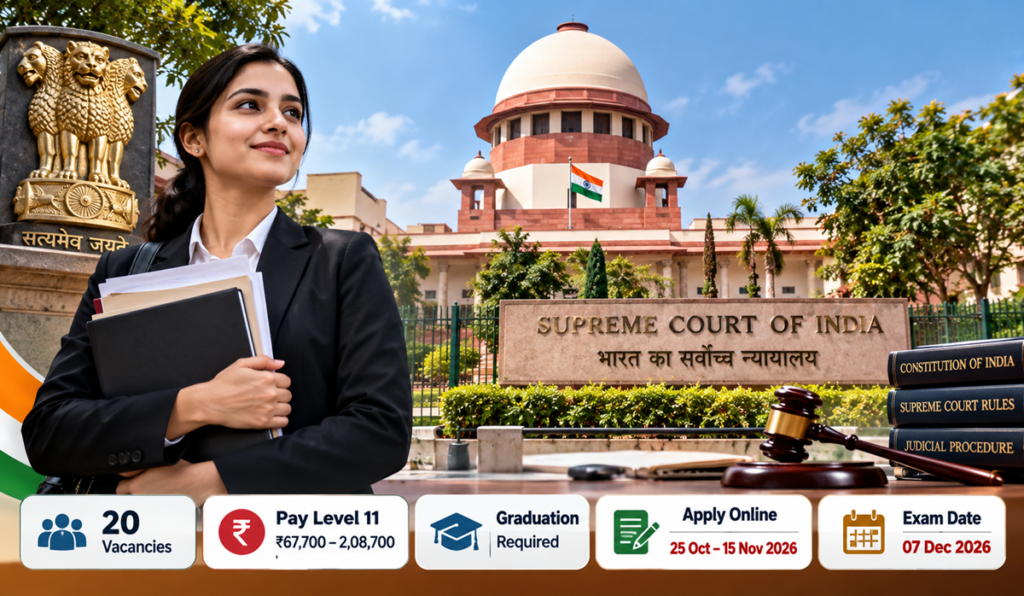
Are you aspiring to secure a prestigious gazetted officer position in the apex judicial institution of India? The Supreme Court of India has officially released the detailed notification No.F.6/11/CM(S)/2026-SC (RC) for direct recruitment to the post of Court Master (Shorthand) in the Registry of the Supreme Court of India.
If you are planning to appear for this highly competitive recruitment drive, having a complete, crystal-clear, and structured understanding of the Supreme Court Recruitment 2026 Syllabus and official exam scheme is your most important strategic advantage. In this ultimate, SEO-friendly, and candidate-centric guide, we provide an in-depth breakdown of every critical component of the selection process—including the subject-wise syllabus, shorthand dictation guidelines, computer typing rules, eligibility requirements, pay scale, step-by-step online application process, state-wise exam center list, and actionable preparation strategies.
Supreme Court Job 2026: Overview & Key Highlights
The Supreme Court of India, situated at New Delhi, functions as the supreme judicial authority and the highest constitutional court in India. To maintain seamless judicial proceedings, administrative operations, and verbatim recording of court judgments and orders, the Supreme Court Registry periodically recruits highly qualified professionals for the gazetted post of Court Master (Shorthand).
The recruitment notification No.F.6/11/CM(S)/2026-SC (RC) dated October 15, 2026, officially invites online applications from eligible candidates across India. Below is a snapshot of all key recruitment parameters:
| Feature / Detail | Official Specification |
|---|---|
| Recruiting Authority | Registry of the Supreme Court of India |
| Advertisement Number | No.F.6/11/CM(S)/2026-SC (RC) |
| Post Title | Court Master (Shorthand) |
| Cadre / Status | Gazetted Post (Group ‘A’/Group ‘B’ Gazetted level equivalent) |
| Tentative Vacancies | 20 Posts (Subject to change as per Registry discretion) |
| Pay Level | Level 11 of Pay Matrix |
| Pay Scale | Rs. 67,700 – Rs. 2,08,700/- (Initial Basic Pay Rs. 67,700/-) |
| Educational Qualification | Graduation Degree in any stream |
| Technical Skill Requirements | English Shorthand Speed: 120 WPM; Typing Speed: 40 WPM |
| Experience Needed | Minimum 5 Years Regular Service as PS/Senior PA/PA/Steno in Govt/PSU |
| Age Limit | Minimum 30 Years and Maximum 45 Years (as on Oct 1, 2026) |
| Selection Mode | Objective Test (100M) + Shorthand Test (100M) + Typing Test (20M) + Interview (30M) |
| Application Mode | Online Mode Only through Official Portal |
| Online Application Dates | October 25, 2026 to November 15, 2026 (11:55 PM) |
| Tentative Written Exam Date | December 7, 2026 |
| Official Website | www.sci.gov.in |
Table of Contents
Table of Contents
Role, Responsibilities & Pay Scale of Supreme Court Job 2026 Court Master
Duties and Expectations
A Court Master (Shorthand) in the Supreme Court Registry occupies a central role during judicial hearings in the courtrooms. Key duties include:
- Taking down verbatim dictations of oral judgments, interim orders, and proceedings dictated by Hon’ble Judges during court sessions.
- Transcribing stenographic notes accurately into clean, error-free legal text within tight judicial deadlines.
- Assisting the Bench in managing case files, paperbooks, cause lists, and official court records during hearings.
- Operating digital record systems, e-filing records, and maintaining strict confidentiality of judicial drafts and orders.
Important Service Condition: Candidates selected for this cadre must be prepared to work even at odd hours and on official court holidays due to urgent bench sittings and heavy case loads. Applicants are required to submit an explicit Undertaking agreeing to work during odd hours without objection.
Pay Matrix Level 11 & Allowances
The post of Court Master (Shorthand) is placed in Level 11 of the Pay Matrix:
- Scale of Pay: Rs. 67,700/- to Rs. 2,08,700/-
- Initial Basic Pay: Rs. 67,700/- per month
- Admissible Allowances: Dearness Allowance (DA), House Rent Allowance (HRA), Transport Allowance (TA), Central Government Health Scheme (CGHS) medical facilities, leave travel concessions (LTC), and annual increments as per Central Government and Supreme Court Rules.
Supreme Court Court Master Vacancy 2026
The Registry of the Supreme Court of India has announced 20 tentative vacancies for the direct recruitment of Court Master (Shorthand).
| Post Name | Department / Cadre | Pay Matrix Level | Total Vacancies |
|---|---|---|---|
| Court Master (Shorthand) | Registry of the Supreme Court of India | Level 11 (Rs. 67,700 – Rs. 2,08,700/-) | 20 (Tentative) |
Registry Rights: The Supreme Court Registry reserves the complete right to alter, increase, decrease, or modify the total number of vacancies or cancel the selection process at any point without prior notice due to administrative exigencies.
Supreme Court Recruitment 2026 Eligibility Criteria
All applicants must fulfill the prescribed educational qualifications, technical skills, service experience, and age limits as on October 1, 2026.
Educational Qualification & Technical Skills
- Graduation Degree: A Bachelor’s degree in any discipline from a recognized University or Institute in India.
- Shorthand Proficiency: Demonstrated speed of 120 words per minute (w.p.m.) in English Shorthand.
- Computer Typing & Operation: Functional knowledge of computer operations along with a minimum computer typing speed of 40 words per minute (w.p.m.) in English.
Mandatory Service Experience Requirement
To be eligible for direct recruitment to Level 11 Court Master post, candidates must possess:
- Minimum 5 years’ regular service in the cadre of:
- Private Secretary (PS)
- Senior Personal Assistant (Senior PA)
- Personal Assistant (PA)
- Senior Stenographer
- The service must be completed in Central/State Government Departments, Public Sector Undertakings (PSUs), Statutory Bodies, or Autonomous Judicial/Government organizations.
Age Limit & Category-wise Relaxations
The age criteria are evaluated as of October 1, 2026:
- Minimum Age Requirement: 30 Years
- Upper Age Limit: 45 Years
Detailed Age Relaxation Table:
| Candidate Category | Age Relaxation Allowed |
|---|---|
| Scheduled Castes (SC) | As per Government of India Rules |
| Scheduled Tribes (ST) | As per Government of India Rules |
| Other Backward Classes (OBC – Non-Creamy Layer) | As per Government of India Rules |
| Ex-Servicemen (ESM) | As per Government of India Rules |
| Dependants of Freedom Fighters | Up to a maximum of 5 years over and above upper limit |
| Departmental Candidates (Supreme Court Registry) | NO Upper Age Limit |
| Other Govt / PSU / Statutory Body / Bank Employees | NO Age Relaxation Applicable |
Supreme Court Recruitment 2026 Exam Pattern & Selection Stages
The selection process for Supreme Court Court Master (Shorthand) Recruitment 2026 consists of four stages:
┌─────────────────────────────────────────────────────────────┐
│ Stage 1: Objective Type Written Test (100 Marks / 90 Mins)  │
└──────────────────────────────┬──────────────────────────────┘
                               │ (Shortlisting Ratio 1:10)
                               ▼
┌─────────────────────────────────────────────────────────────┐
│ Stage 2: English Shorthand Test (100 Marks / 120 WPM)      │
│ Stage 3: Computer Typing Speed Test (20 Marks / 40 WPM)     │
└──────────────────────────────┬──────────────────────────────┘
                               │ (Shortlisting Ratio 1:3)
                               ▼
┌─────────────────────────────────────────────────────────────┐
│ Stage 4: Personal Interview (30 Marks)                      │
└──────────────────────────────┬──────────────────────────────┘
                               │
                               ▼
┌─────────────────────────────────────────────────────────────┐
│         Final Select Panel & Document Verification          │
└─────────────────────────────────────────────────────────────┘
Official Scheme of Examination Table:
| Stage | Test Name & Subject Details | Questions | Max Marks | Min Qualifying Marks | Duration |
|---|---|---|---|---|---|
| Stage 1 | Objective Type Written Test1. General English (25 Qs)2. General Knowledge (25 Qs)3. Provisions relating to Judiciary in Indian Constitution (25 Qs)4. Supreme Court Rules, 2013 (15 Qs)5. Knowledge of Computer Operation (10 Qs) | 100 Qs | 100 Marks | 50 Marks (50%) | 1 ½ Hours (90 Mins) |
| Stage 2 | Shorthand (English) Test– Dictation @ 120 WPM- Transcription on Computer | Dictation Passage | 100 Marks | 50 Marks (50%) | 7 Mins Dictation45 Mins Transcription |
| Stage 3 | Computer Typing Speed Test– English Typing @ Min 40 WPM | Typing Passage | 20 Marks | 10 Marks (50%) | 10 Minutes |
| Stage 4 | Personal Interview | Evaluation | 30 Marks | 15 Marks (50%) | Personal Interaction |
| TOTAL | Aggregate Selection Framework | — | 250 Marks | — | — |
Crucial Examination Guidelines:
- No Negative Marking: There is NO negative marking in the Objective Written Test. Candidates should attempt all 100 questions.
- Mandatory Qualifying Benchmark: Candidates must secure at least 50% marks in each individual test component to be considered eligible for the next phase.
- Medium of Examination: All papers and skill tests will be conducted strictly in the English language.
Complete Topic-Wise Supreme Court Recruitment 2026 Syllabus
A deep dive into the official Supreme Court Recruitment 2026 Syllabus is essential for effective preparation. Below is the exhaustively detailed subject-wise breakdown for all five subjects included in the Stage 1 Objective Written Test:
Section 1: General English Syllabus (25 Marks)
The General English segment tests command over English grammar, vocabulary, sentence construction, comprehension, and specialized legal language:
- Grammatical Foundations:
- Parts of Speech (Nouns, Pronouns, Verbs, Adjectives, Adverbs, Prepositions, Conjunctions, Interjections).
- Tenses and Aspect Rules.
- Subject-Verb Agreement (Syntax).
- Articles and Determiners.
- Modals and Auxiliary Verbs.
- Vocabulary Enhancement:
- Synonyms and Antonyms (General & Legal context).
- One-Word Substitutions.
- Idioms, Phrases, and Phrasal Verbs.
- Correct Spelling Rules & Commonly Confused Words.
- Latin Legal Terms & Maxims (e.g., Amicus Curiae, Habeas Corpus, Suo Motu, Sub Judice, Ratio Decidendi, Obiter Dicta, Bona Fide, Prima Facie).
- Sentence Structure & Correction:
- Spotting Errors in Sentences.
- Sentence Improvement & Phrase Replacement.
- Sentence Completion & Cloze Test.
- Sentence Rearrangement (Para Jumbles).
- Voice & Narration:
- Active Voice to Passive Voice transformation and vice-versa.
- Direct Speech to Indirect Speech conversion (Reported Speech).
- Reading Comprehension:
- Legal, social, and general passages.
- Fact-based questions, main idea identification, vocabulary in context, and drawing inferences.
Section 2: General Knowledge & Current Affairs Syllabus (25 Marks)
This section measures awareness across national affairs, Indian polity, history, geography, economy, science, and judicial heritage:
- Indian Polity & Constitutional Governance:
- Evolution of Indian Constitution, Preamble, Citizenship, Fundamental Rights, Fundamental Duties, Directive Principles of State Policy (DPSP).
- Structure of Executive, Union Parliament, State Legislatures, Emergency Provisions.
- Indian History & Freedom Movement:
- Ancient, Medieval, and Modern Indian History.
- Key movements in the Freedom Struggle, role of prominent leaders, historic treaties and constitutional reforms prior to 1947.
- Geography & Natural Resources:
- Physical Geography of India (Rivers, Mountains, Climate, Soil, Vegetation).
- State boundaries, National Parks, Biosphere Reserves, and important infrastructure projects.
- Indian Economy:
- Indian Economic Architecture, National Income, Budgeting, Union Budget highlights, Taxation, Banking System, Monetary Policy by RBI, Inflation indices.
- General Science & Everyday Technology:
- Elementary concepts in Physics, Chemistry, Biology, Environmental Ecology, and Recent Scientific Breakthroughs (ISRO missions, AI advancements, IT reforms).
- Current Affairs & Recent Events:
- National & International events of significance during the past 12 months.
- Important Supreme Court judgments in news, Constitutional Bench rulings, appointments of Judges, legal reforms, awards, sports, and international summits.
- Judicial History & Static Legal Knowledge:
- History of Supreme Court of India (established on January 28, 1950).
- Former Chief Justices of India, iconic courtrooms, statutory commissions (Law Commission of India, NHRC, NALSA).
Section 3: Judiciary Provisions in Constitution of India Syllabus (25 Marks)
This is the most specialized core section in the Supreme Court Recruitment 2026 Syllabus. Candidates must possess thorough knowledge of Constitutional Articles pertaining to Indian Judiciary:
Supreme Court Job 2026: Detailed Article-Wise Constitutional Breakdown:
- Part V, Chapter IV – The Union Judiciary (Articles 124 to 147):
- Article 124: Establishment and Constitution of the Supreme Court of India; appointment, tenure, age limit (65 years), and impeachment procedure of Supreme Court Judges.
- Article 124A, 124B, 124C: Historical overview of NJAC and National Judicial Appointments Commission provisions.
- Article 125: Salaries, allowances, pensions, and privileges of Judges.
- Article 126 & 127: Appointment of Acting Chief Justice and Ad hoc Judges in Supreme Court.
- Article 128: Attendance of retired Judges at sittings of the Supreme Court.
- Article 129: Supreme Court to be a Court of Record and its power to punish for contempt of itself.
- Article 130: Seat of the Supreme Court (New Delhi) and circuit benches provisions.
- Article 131: Original Jurisdiction of the Supreme Court (Disputes between GoI and States or between States).
- Article 131A: Executive jurisdiction in questions regarding constitutional validity of Central laws (repealed/historical).
- Article 132: Appellate Jurisdiction in appeals from High Courts in constitutional cases.
- Article 133: Appellate Jurisdiction in civil matters.
- Article 134: Appellate Jurisdiction in criminal matters.
- Article 134A: Certificate for appeal to the Supreme Court.
- Article 135: Jurisdiction and powers of the Federal Court under existing law to be exercisable by Supreme Court.
- Article 136: Special Leave to Appeal (SLP) by the Supreme Court (Discretionary power of Supreme Court).
- Article 137: Power of the Supreme Court to review its own judgments or orders.
- Article 138: Enlargement of the jurisdiction of the Supreme Court.
- Article 139: Conferment on the Supreme Court of powers to issue certain writs.
- Article 139A: Transfer of certain cases from High Courts to Supreme Court.
- Article 140: Ancillary powers of Supreme Court.
- Article 141: Law declared by Supreme Court to be binding on all courts within the territory of India (Precedent Doctrine / Stare Decisis).
- Article 142: Enforcement of decrees and orders of Supreme Court and orders as to discovery, etc. (Doing Complete Justice).
- Article 143: Advisory Jurisdiction – Power of President to consult Supreme Court.
- Article 144: Civil and judicial authorities to act in aid of the Supreme Court.
- Article 145: Rules of Court – Powers of Supreme Court to make rules governing practice, Constitution Benches (min 5 judges), and procedures.
- Article 146: Officers and servants and expenses of the Supreme Court (Administrative autonomy of CJI).
- Article 147: Interpretation of constitutional provisions.
- Writ Jurisdiction under Constitution:
- Article 32: Right to Constitutional Remedies (Heart and Soul of Constitution) – 5 Writs: Habeas Corpus, Mandamus, Prohibition, Quo Warranto, Certiorari.
- Article 226: Power of High Courts to issue writs.
- Part VI, Chapter V & VI – High Courts & Subordinate Courts:
- Articles 214 to 231: High Courts structure, appointments, jurisdiction, supervisory power over subordinate courts under Article 227.
- Articles 233 to 237: Appointment of District Judges, judicial service cadre control.
- Fundamental Judicial Principles:
- Basic Structure Doctrine (Kesavananda Bharati case).
- Independence of Judiciary & Separation of Powers (Article 50).
- Judicial Review, Public Interest Litigation (PIL), Collegium System vs Executive role.
Section 4: Supreme Court Rules, 2013 Syllabus (15 Marks)
This module evaluates procedural awareness regarding the official Supreme Court Rules, 2013 governing court functioning, Registry procedures, and Court Master responsibilities:
Supreme Court Job 2026: Key Procedural Coverage Areas:
- Structure of Supreme Court Rules, 2013: Parts, Orders, Rules, Schedules, and prescribed forms.
- Part I – General Provisions (Orders I to IV):
- Interpretation, definitions (Advocate-on-Record, Registrar, Party, Court Master).
- Sittings of Court, Registry working hours, Court vacations, summer vacation benches, computation of limitation period.
- Part II – Officers of Court & Advocates (Orders V to VIII):
- Role, duties, and powers of Registrars and Registry Officers.
- Advocate-on-Record (AoR) examination, eligibility, rights, and duties.
- Senior Advocates designation rules.
- Duties of Court Masters in courtrooms during hearings.
- Part III – Filings, Pleadings & Caveats (Orders IX to XVI):
- Mode of presentation of petitions, memo of appeal, formatting of paperbooks.
- Scrutiny of petitions, defect removal process by AoRs.
- Caveat filing procedure under Order V (right to be heard before interim ex-parte orders).
- Service of summons, notices, affidavits, and undertakings.
- Part IV – Listing, Cause Lists & Hearing Procedure (Orders XVII to XX):
- Preparation and publication of Daily Cause List, Weekly List, Advance List.
- Listing of Special Leave Petitions (SLPs), Writ Petitions, Review Petitions.
- Constitution Benches listing, urgent pass-overs, and adjournment rules.
- Part V – Paperbooks, Records & Certified Copies:
- Preparation of official court paperbooks, translated transcripts, volume binding standards.
- Inspection of records, certified copies application rules.
- Part VI – Review, Curative & Contempt Proceedings:
- Procedure for filing Review Petitions under Article 137 (Order XLVII).
- Procedure for filing Curative Petitions (Rupa Ashok Hurra case principles).
- Contempt of Court proceedings rules (Civil Contempt & Criminal Contempt).
Section 5: Knowledge of Computer Operation Syllabus (10 Marks)
As Court Masters utilize automated court management software, digital audio recording systems, e-filing portals, and word processing systems, basic IT proficiency is evaluated:
- Computer Basics & Hardware: Central Processing Unit (CPU), RAM, ROM, primary/secondary storage, input/output peripherals (keyboards, steno-machines, digital sound recorders, printers, scanners).
- Operating Systems & File Management:
- Windows OS features, file directories, file extensions (.docx, .pdf, .txt, .rtf).
- Creating, moving, renaming, compressing (zip), and securing files.
- Word Processing (MS Word & OpenOffice):
- Document formatting, page orientation, margins, line spacing, font styles, headers & footers.
- Inserting tables, track changes, comments, spell check, find & replace.
- Shortcut keys for rapid editing and navigation (Ctrl+C, Ctrl+V, Ctrl+Z, Ctrl+F, Ctrl+H, Ctrl+S, etc.).
- Spreadsheets (MS Excel):
- Worksheet basics, cells, rows, columns, basic formulas (SUM, AVERAGE, COUNT), sorting and filtering data.
- Internet, Emailing & Court Software:
- Web browsers, search techniques, e-filing portal usage, digital signatures (DSC).
- Composition of emails, managing attachments, cybersecurity practices, phishing prevention, data privacy.
Supreme Court Job 2026: Shorthand & Typing Error Evaluation Rules (Gradation Method)
Candidates appearing for Stage 2 (Shorthand Test) and Stage 3 (Typing Test) must adhere strictly to speed and error accuracy benchmarks.
Stage 2: Shorthand (English) Test Scheme & Gradation
- Dictation Speed: 120 words per minute (w.p.m.) for 7 minutes (Total 840 words).
- Transcription Duration: 45 minutes on computer.
- Maximum Marks: 100 Marks (Minimum Qualifying: 50 Marks).
- Maximum Permissible Error Limit: 5% of total words dictated (Maximum 42 errors out of 840 words).
Official Shorthand Gradation Method Chart:
| Percentage of Mistakes in Shorthand Passage | Gradation Marks Awarded | Qualification Status |
|---|---|---|
| 0% Mistakes (Flawless Transcription) | 100% Marks (100 / 100) | Qualified |
| Up to 1% Mistakes (1 to 8 errors) | 90% Marks (90 / 100) | Qualified |
| Up to 2% Mistakes (9 to 16 errors) | 80% Marks (80 / 100) | Qualified |
| Up to 3% Mistakes (17 to 25 errors) | 70% Marks (70 / 100) | Qualified |
| Up to 4% Mistakes (26 to 33 errors) | 60% Marks (60 / 100) | Qualified |
| Up to 5% Mistakes (34 to 42 errors) | 50% Marks (50 / 100) | Qualified (Minimum) |
| Exceeding 5% Mistakes (>42 errors) | Disqualified (<50 Marks) | Disqualified |
Shorthand Mistake Evaluation Rules:
- Full Mistake: Omission, addition, or substitution of any word or figure.
- Half Mistake:
- The mistake of a full stop (.) is counted as a half mistake.
- Wrong typing of a capital letter for a small letter or vice-versa is counted as a half mistake.
Stage 3: Computer Typing Speed Test Scheme
- Test Duration: 10 minutes.
- Minimum Speed Required: 40 words per minute (w.p.m.) in English.
- Maximum Marks: 20 Marks (Minimum Qualifying: 10 Marks).
- Maximum Permissible Mistakes: 2% of total words typed.
Typing Mistake Evaluation Rules:
- Full Mistake: Error in respect of any word or figure.
- Half Mistake:
- Wrong typing of a capital letter for a small letter or vice-versa.
- Punctuation mark omitted, added, or substituted by another punctuation mark.
Supreme Court Job 2026: Shortlisting Ratios & Selection Procedure
The shortlisting framework followed by the Supreme Court Recruitment Cell is structured as follows:
- Stage 1 to Stage 2 & Stage 3 Shortlisting (Ratio 1:10):
- Candidates securing a minimum of 50 marks (50%) in Stage 1 Objective Test qualify.
- Among these qualified candidates, candidates will be shortlisted for Stage 2 (Shorthand Test) and Stage 3 (Typing Test) in the ratio of 1:10 as per vacancy merit list.
- Stage 2 & 3 to Stage 4 Shortlisting (Ratio 1:3):
- Candidates who successfully pass Stage 1, Stage 2 (min 50% marks), and Stage 3 (min 50% marks) will be shortlisted for Stage 4 (Personal Interview) in the ratio of 1:3.
- Final Select Panel Preparation:
- The final select panel of candidates will be prepared strictly in order of merit based on aggregate performance across the selection process. Placement on the select panel does not automatically confer an absolute right to appointment.
Supreme Court Recruitment 2026 Important Dates
Ensure you adhere to all official recruitment milestones:
| Recruitment Event / Activity | Official Timeline |
|---|---|
| Official Advertisement Publication | October 15, 2026 |
| Eligibility Crucial Cut-Off Date | October 1, 2026 |
| Online Application Registration Start Date | October 25, 2026 |
| Online Application Registration Last Date | November 15, 2026 (up to 11:55 PM) |
| Tentative Objective Written Examination Date | December 7, 2026 |
| Answer Key Upload Date | December 8, 2026 (Tentative) |
| Answer Key Objection Submission Window | December 8 to December 9, 2026 (11:55 PM) |
| Shorthand & Typing Speed Test Dates | To be notified on sci.gov.in |
| Personal Interview Schedule | To be notified on sci.gov.in |
Supreme Court Recruitment 2026: Application Fee & Payment Gateway Details
The application fee is non-refundable and must be paid through the online UCO Bank payment gateway integrated into the application portal:
| Candidate Category | Application Fee Amount |
|---|---|
| General / Unreserved Category | Rs. 1,500/- + Bank Charges |
| Scheduled Castes (SC) / Scheduled Tribes (ST) | Rs. 750/- + Bank Charges |
| Other Backward Classes (OBC – Non-Creamy Layer) | Rs. 750/- + Bank Charges |
| Ex-Servicemen (ESM) | Rs. 750/- + Bank Charges |
Payment Instructions: Fees will not be accepted via Demand Draft, Indian Postal Order, or cash. Unsigned or unpaid applications will be rejected outright.
Supreme Court Recruitment 2026: Step-by-Step Guide: How to Apply Online
Follow this simple, step-by-step process to fill out your online application form smoothly:
[Visit Official Portal: sci.gov.in]
                 │
                 ▼
[Complete Online Registration & Get Application No.]
                 │
                 ▼
[Fill Personal, Education & 5-Year Experience Details]
                 │
                 ▼
[Upload Photograph, Signature & Verified Certificates]
                 │
                 ▼
[Preview Application Form Carefully & Confirm]
                 │
                 ▼
[Pay Application Fee via UCO Bank Gateway]
                 │
                 ▼
[Print & Retain Completed Form for Future Reference]
- Step 1: Access Official Web Portal: Visit the official website of the Supreme Court of India at [www.sci.gov.in]and click on the Recruitment link.
- Step 2: Candidate Registration: Click on Court Master (Shorthand) Application 2026 and complete registration by entering your full name (as per High School X Certificate), date of birth, mobile number, and active email address.
- Step 3: Fill Application Details: Input educational qualifications, 5-year experience credentials, category details, and exercise city choices for Objective Test centers.
- Step 4: Upload Required Documents: Upload scanned copies of the following documents:
- Passport-size photograph and official signature
- Class 10th (High School) Certificate (Proof of Date of Birth)
- Class 12th Certificate and Graduation Degree Certificate
- 5 Years Regular Service Experience Certificate in prescribed cadre
- Caste / Community / Non-Creamy Layer Certificate (if seeking reservation).
- Step 5: Form Preview & Final Confirmation: Carefully review all populated fields. Once submitted, modifications or category changes are not permitted.
- Step 6: Pay Online Fee: Pay the fee via net banking, credit card, debit card, or UPI through UCO Bank payment gateway.
- Step 7: Print Application Form: After successful payment, download and print the finalized application form. Do not post the hard copy to the Registry.
Supreme Court Job 2026: Exam Centers List (Annexure A Summary)
The Objective Type Written Test will be conducted across 69+ test cities in various States/UTs as detailed in Annexure A of the official advertisement.
Regional Breakdown of Objective Test Centers:
- Bihar: Bhagalpur, Muzaffarpur, Patna.
- Jharkhand: Bokaro Steel City, Dhanbad, Ranchi.
- Odisha: Bhubaneswar/Cuttack, Dhenkanal, Rourkela.
- Assam & West Bengal: Guwahati, Kolkata, Siliguri.
- Delhi / NCR: Delhi / NCR.
- Uttar Pradesh: Agra, Aligarh, Bareilly, Jhansi, Kanpur, Lucknow, Meerut, Moradabad, Muzaffarnagar, Prayagraj, Varanasi.
- Uttarakhand & Haryana: Dehradun, Roorkee, Ambala, Kurukshetra.
- Rajasthan: Ajmer, Bikaner, Jaipur, Jodhpur, Udaipur.
- Himachal Pradesh: Hamirpur, Kangra, Shimla.
- Jammu & Kashmir / Ladakh: Jammu, Srinagar, Leh.
- Punjab: Amritsar, Bathinda, Ludhiana, Mohali, Pathankot, Patiala, Phagwara.
- Southern States: Guntur, Visakhapatnam, Hyderabad, Warangal, Belagavi, Bengaluru, Mysuru, Ernakulam, Thiruvananthapuram, Chennai, Coimbatore.
- Western & Central States: Ahmedabad/Gandhinagar, Rajkot, Chhatrapati Sambhaji Nagar, Mumbai, Nagpur, Pune, Bhilai, Raipur, Bhopal, Gwalior, Indore, Jabalpur.
Note on Skill Tests: The Shorthand (English) Test and Typing Speed Test will be conducted exclusively in Delhi/NCR. The Interview will be conducted either in physical mode in Delhi or through online mode as decided by the competent authority.
Proven Preparation Strategy & Subject-Wise Study Plan for Supreme Court Recruitment Exam 2026
- Constitutional Judiciary Master Plan (Articles 124–147 & 32):
- Make handwritten summary charts for all Articles under Part V Chapter IV. Focus heavily on Original Jurisdiction (Art 131), Appellate Jurisdiction (Arts 132–134), Special Leave Petitions (Art 136), Review (Art 137), Advisory Jurisdiction (Art 143), and Court of Record (Art 129).
- Supreme Court Rules, 2013 Mastery:
- Focus on key procedural definitions, AoR rules, caveat filings, paperbook formatting, and listing protocols.
- Daily Shorthand Speed Dictation at 125–130 WPM:
- Practice legal dictation passages containing legal terms, judicial phrases, and statute citations.
- Aim for 125–130 WPM in daily shorthand dictation practice so that taking dictation at 120 WPM during the actual test feels comfortable.
- Rigorously check transcriptions for full stop omissions and capitalization errors to avoid losing marks under the 5% error cap.
- Computer Typing & Accuracy Maintenance:
- Practice daily computer typing tests for 10–15 minutes on standard software to consistently achieve 45–50 WPM with error rates below 1.5%.
- Full-Length Mock Tests & Time Management:
- Solve objective mock sets covering General English, General Knowledge, Judiciary Provisions, Supreme Court Rules, and Computers within the 90-minute limit. Since there is no negative marking, build a strategy to attempt all 100 questions accurately.
Supreme Court Recruitment 2026: Notification PDF

Supreme Court Recruitment 2026 Important Links
| Important Link Description | Official Direct Link |
|---|---|
| Apply Online Portal Link | [Click Here to Register & Apply Online] |
| Official Notification PDF | [Download Official Advertisement PDF] |
| Supreme Court Official Website | [Visit www.sci.gov.in] |
Frequently Asked Questions on Supreme Court Recruitment 2026
Q1. What is the online application start date for Supreme Court Court Master Recruitment 2026?
Ans. The online registration for application starts on October 25, 2026.
Q2. What is the last date to submit the online application form?
Ans. The last date for submission of online application is November 15, 2026 (up to 11:55 PM).
Q3. How many vacancies are announced in Supreme Court Court Master Recruitment 2026?
Ans. There are 20 tentative vacancies announced for the post of Court Master (Shorthand).
Q4. What educational qualification and technical skills are required?
Ans. Candidates must hold a Bachelor’s degree, possess 120 w.p.m. English Shorthand speed, and 40 w.p.m. computer typing speed.
Q5. What is the mandatory experience needed to apply for Court Master?
Ans. Candidates must possess a minimum of 5 years’ regular service in the cadre of PS/Senior PA/PA/Senior Stenographer in Government/PSU/Statutory bodies.
Q6. What is the age limit for Supreme Court Recruitment 2026 applicants?
Ans. Applicants must be between 30 and 45 years of age as on October 1, 2026.
Q7. What is the pay scale for Court Master (Shorthand) in the Supreme Court?
Ans. The post is placed in Pay Level 11 (Rs. 67,700 – Rs. 2,08,700/-) with initial Basic Pay of Rs. 67,700/- plus allowances.
Q8. Is there any negative marking in the Objective Type Written Test?
Ans. No, there is no negative marking in the Objective Type Test.
Q9. What is the maximum permissible error limit in the Shorthand Test?
Ans. The maximum permissible mistake limit in the English Shorthand Test is 5% of total words dictated.
Q10. Will admit cards for the exam be sent by post?
Ans. No, admit cards will not be sent by post and must be downloaded from the website www.sci.gov.in.

1 thought on “Supreme Court Recruitment 2026: Official Syllabus, Exam Pattern, Eligibility & Full Selection Process Guide”